
How AI turned a three-partner consultancy into a 10× software house
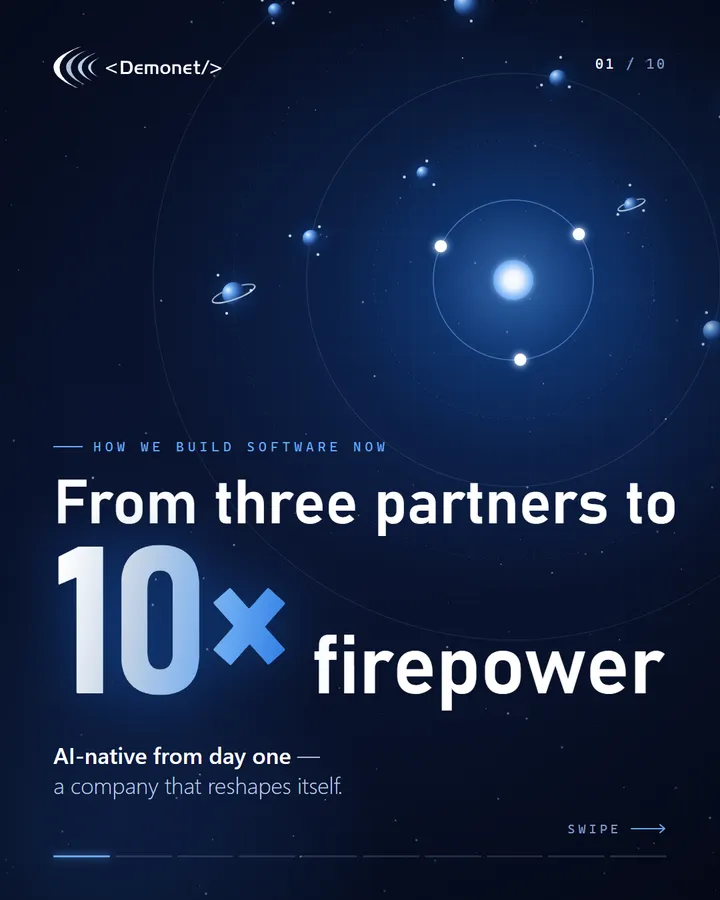
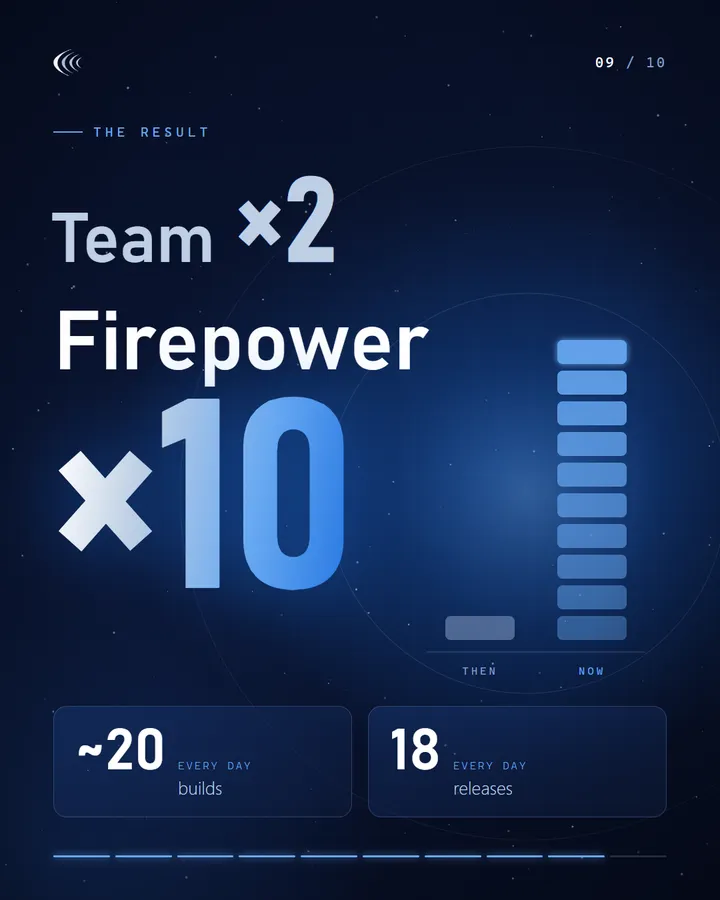
A few years ago Demonet was three partners doing IT consulting. Today the team has doubled and our capacity has grown about tenfold. We didn't bolt AI on later: we built the company around it, so it can reshape itself every time the technology moves.
Three partners.Twice the team.Ten times the firepower.
Where we started
Demonet began as three partners doing IT consulting. Our customers trusted us, but our reach was limited by our own hours. Every project meant late nights, a lot of manual work and too little time left over to build our own products.
Today the company looks very different. The team has doubled, and our real output has grown by roughly an order of magnitude. What we can ship in a week used to take a quarter.
In short, we didn't add an AI tool to our workflow. We rebuilt the workflow as a network.
AI from the very beginning
AI wasn't an afterthought for us. Demonet has worked with AI from the very beginning, and that is its defining trait: an organisation built around AI can shape itself, and reshape itself again, every time the technology moves. New model, new tool, new way of working: we change the network rather than the people.
Every machine is a node
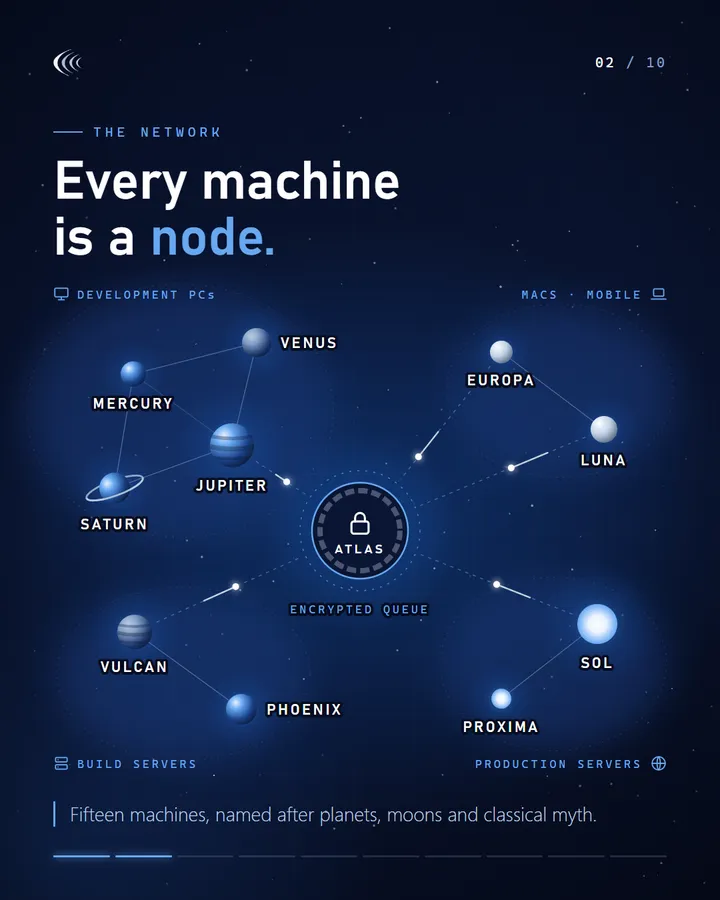
At the heart of Demonet there is now a network of fifteen machines, and each has a role.
- Development PCs and Macs
- AI agents write code, fix defects and build mobile apps for Android and iOS.
- Build servers
- They compile, sign and publish every release.
- Production servers
- They run our products and our customers' installations.
- The queue
- A central message queue, encrypted end to end and reachable only with client certificates, that every order passes through.
- The vault
- Nightly backups, encrypted and copied off-site.
15 nodes today
and growing
Fifteen today, more tomorrow
The network isn't finished: we extend it day by day. A repeatable process brings a new machine on board. It installs the agents, applies the same security standard, registers the node with the queue and puts it on the Live Network.
- Physical servers
- Virtual machines
- Cloud VPS
- Office PCs
- Macs
- Next: small boards like the Raspberry Pi
Small boards will take the network closer to where the work happens.
Every machine has a name from the sky or from classical myth. It's a nod to two of our passions, astronomy and the classics, and a good way to remember what each one does: Atlas carries the queue on its shoulders, Vulcan forges the builds, Phoenix rises with every release.
- Mercury
- Jupiter
- Saturn
- Venus
- Mars
- Uranus
- Pluto
- Earth
- Europa
- Luna
- Atlas
- Vulcan
- Phoenix
- Proxima
- Sol
Every node has satellites
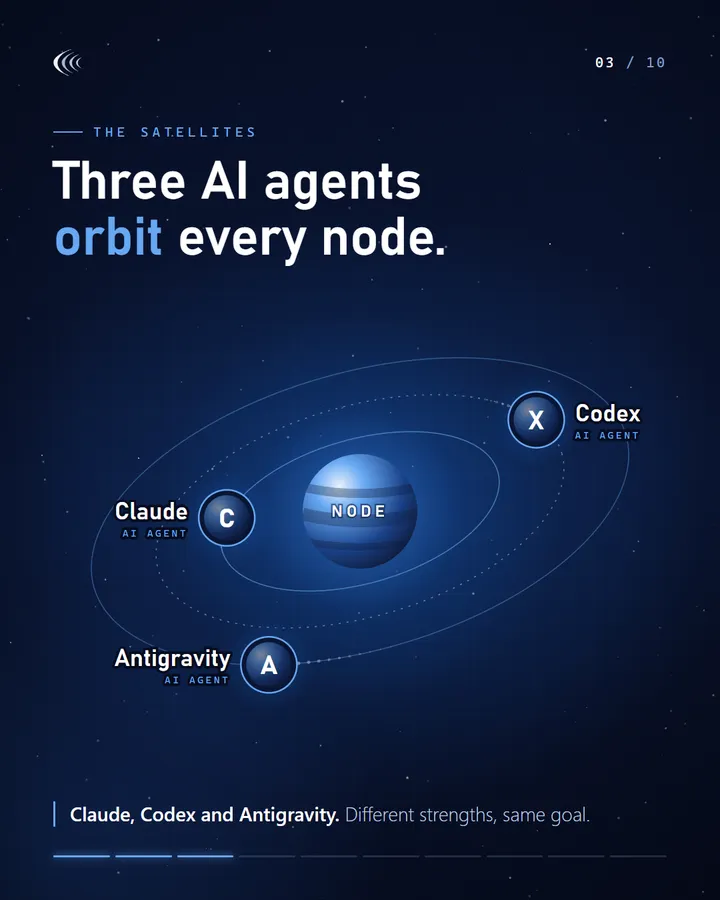
Three AI agents orbit each development machine: Claude, Codex and Antigravity. They have different strengths and work on the same order. One plans, another writes, a third double-checks.
- Claude
- Codex
- Antigravity
On the Live Network, the single screen where we watch the whole network at work, you can see them as small moons around each planet.
A director, and a verifier who isn't the author
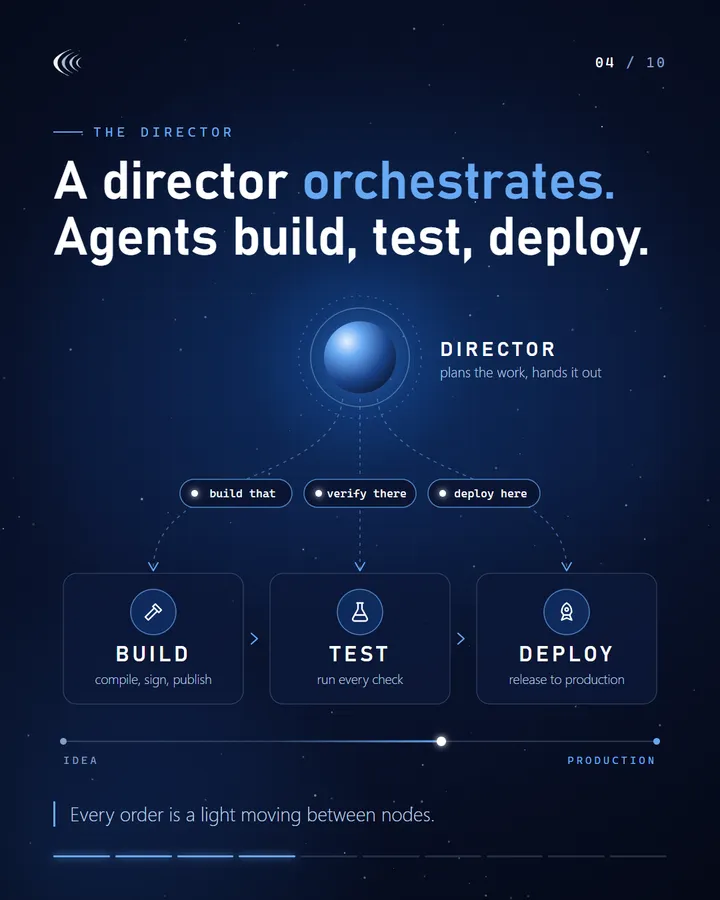
One agent acts as the director. It keeps the plan for each project, decides what happens next and writes the orders: fix this, build that, deploy here, verify there. Other agents pick up the orders addressed to them, do the work and report back. On the Live Network each order is a light moving between nodes.
On an ordinary day that adds up to around twenty builds and eighteen production releases, with an average lead time of a few minutes per step.
Speed alone would be dangerous, so the network has rules no agent can skip.
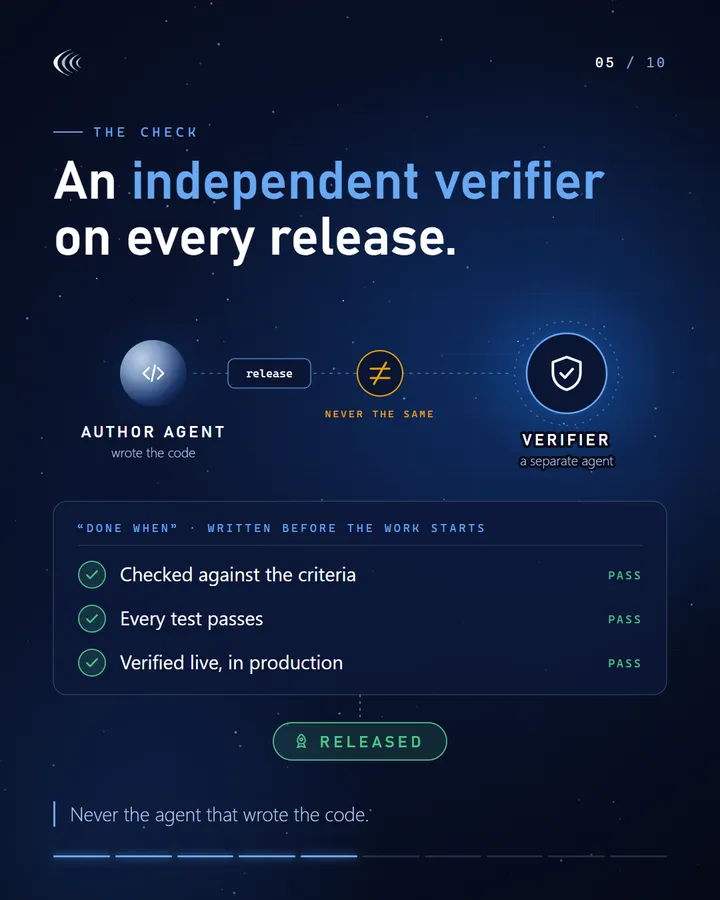
- An independent verifier for every release. The agent that wrote the code is never the one that approves it. A separate agent checks the release against the “done when” criteria written before the work started, first with tests and then live in production.
- Adversarial testing. For sensitive parts such as our AI privacy guard, the verifier's job is to break the code. Every hole it finds becomes a fixed test case.
- Rules that become code. If a number says 12, the list behind it shows 12 rows. Buttons never move. Maps always show administrative boundaries. A rule written once is checked forever.
- Humans decide. Destructive operations, budgets and anything a customer will see first require a decision from the team.
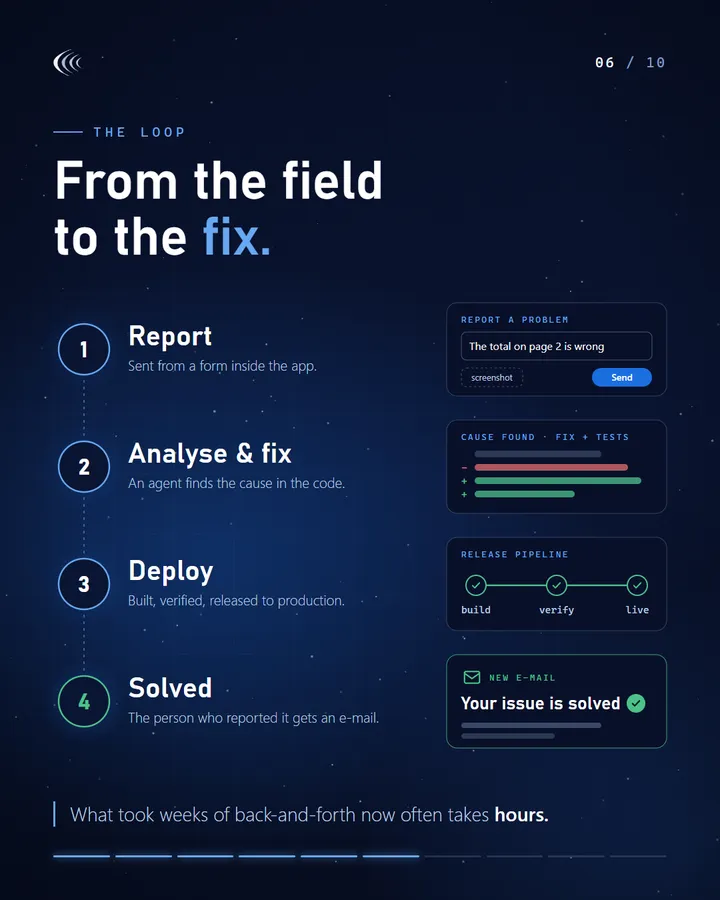
From the field to the fix
Our products have report forms built in. A site manager on a construction site, a customer's back-office clerk or a beta tester can report a problem, or ask for an improvement, right where it happens, with a screenshot attached. These reports don't land in someone's inbox. They go straight into the network.
- An agent receives the report, analyses it and finds the cause.
- It writes the fix, with its tests.
- A build server prepares the release, and a production server brings it to the field.
- An independent verifier checks the fix on the live product.
- The person who reported the problem gets an e-mail in plain language: what was wrong, what we changed, and that it's solved.
Fixes that used to take weeks of back-and-forth now often take hours.
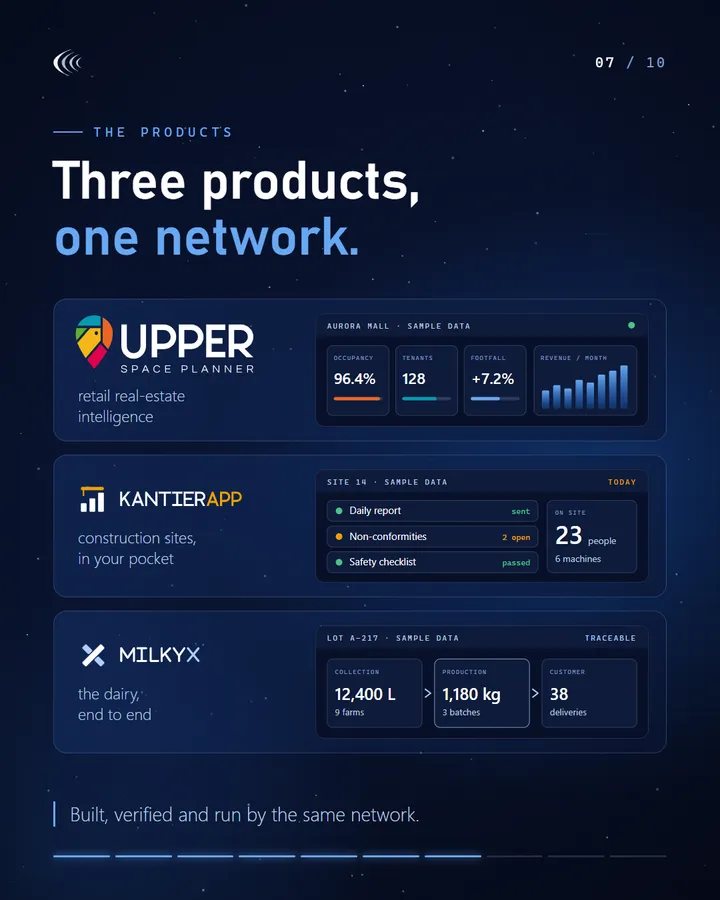
Three products, one network
The same network builds and runs our products.
 A platform for people who manage retail real estate: contracts, occupancy, revenue, receivables and budgets, plus an “ask a question” assistant that turns plain-language questions into reports.Discover Upper
 The construction site in your pocket: daily reports, non-conformities, safety, people and equipment, with a mobile app built for the site rather than the office.Discover KantierApp
 The dairy from end to end, from collection to production to the customer, with traceability built in.Discover MilkyX
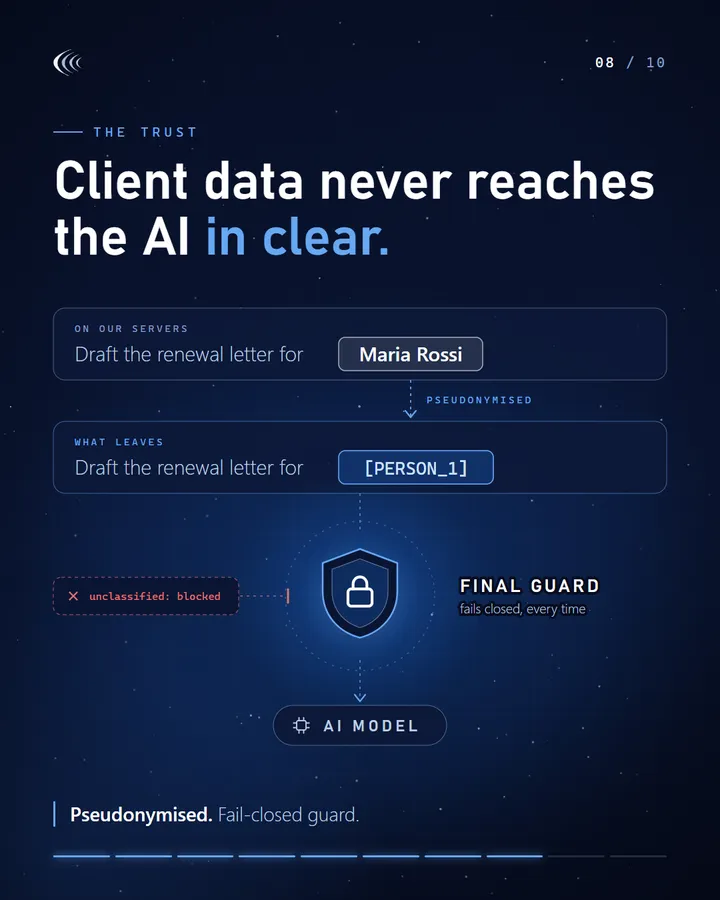
Client data never reaches the AI in clear
AI is only useful if customers can trust it. Our rule is simple and absolute: no client data reaches an AI model in clear text.
- Pseudonymisation
- Before any request leaves our servers, names of people, companies, sites and places are replaced with placeholders. The real names are restored only on our side, after the answer comes back.
- A guard that fails closed
- A final guard inspects every outgoing request. If it finds anything it cannot classify with certainty, such as a phone number, a tax code, a bank account or an e-mail address, it blocks the request and the user gets a deterministic answer instead. It never sends “just to try”.
- Hardened by attack
- Independent verifiers keep attacking the guard with encoded text, split numbers, foreign formats and very long inputs. Every round makes it stricter without blocking normal business language.
- Tested like a customer
- Every AI feature is checked with dozens of questions written the way real users write them, typos included. One wrong answer on screen is enough to block a release. When the assistant isn't sure it understood, it says so: “Here is what I understood, is that right?”
A small company after the asteroid
We sometimes think of AI as our industry's Chicxulub: the asteroid that hit the Yucatán sixty-six million years ago. It didn't end life on Earth. It changed who the actors were. The giants of the time struggled, and smaller creatures, quicker to adapt, ended up shaping something entirely new.
We don't pretend to know how this story ends, and we are certainly not the most important player in it. But we feel lucky to be small at a moment like this. A small team that rethinks how it works every few weeks can try things that are much harder for large organisations, and we are learning from our mistakes in public, one release at a time.
People stay at the centre
The agents didn't replace our team; they changed what the team does. The partners and developers now spend their time on product decisions, on customers, and on the rules the network follows. Some things stay with people:
- product choices and priorities;
- budgets;
- anything that touches production data;
- the final word on what a customer sees.
The result is a company that is still small, and still personal with its customers, but with the reach of a much larger one.
Want to see the Live Network in action?
Demonet builds software for real estate, construction and the food industry. Tell us what you need to build: we'll show you how the network would take it from idea to release.